Your front desk answers the same questions every day. Write them down once.
"What time do you close?" "Can she eat before surgery?" Your team answers these all day. A written FAQ gives owners the same right answer every time, and gives your front desk a break.

November 2026
6 min read
Every clinic has its "top ten": the questions your front desk answers so often they could say them in their sleep. Each call only takes a minute or two, but across a busy week those minutes add up, and they always arrive at the worst moment, like when there's a dog on the scale and a queue at the desk.
Writing the answers down once gives owners a faster answer, gives every staff member the same answer, and frees up the phone for the calls that really need a person.
Count the questions for one week
Keep a sheet by the phone. Every time someone asks something routine, add a mark next to it. After a week you'll know exactly which questions matter. It often looks something like this:
| Question | This week |
|---|---|
| What time do you open / close? | ||||| |||| |
| Can my pet eat before surgery? | ||||| | |
| Is my pet due for a vaccine? | ||||| |
| How much does a checkup cost? | |||| |
| Where do I park? | ||| |
The example above is just to show the idea. Your own list is the one that counts.
Write each answer the way your vets would say it
Short, plain words, and specific to your clinic. Ask one of your vets to read the medical ones before you publish them, so the advice matches what they tell owners in the room.
Keep a "call us now" list
An FAQ should never stop an owner from calling when they need to. Put a short, clear list at the top: signs that mean "call the clinic straight away". Many clinics include things like:
- trouble breathing or collapse,
- possible poisoning (chocolate, medicines, rat bait, antifreeze),
- straining without passing urine, especially in male cats,
- a swollen, hard belly with retching in a dog,
- seizures, heavy bleeding, or repeated vomiting.
Ask your vets to confirm the list and add anything specific to the animals you see.
Put it where owners already look
An FAQ hidden on page five of your website doesn't help anyone. Share it in the places owners already are: your website's home page, the bottom of your reminder messages, a printed sheet at the desk, and the welcome message for new clients.
Review it every few months
Opening hours change, prices change, a new vet joins. Put a date in the calendar every three months to read the FAQ again and fix anything out of date. An old answer is worse than no answer.
Let the FAQ answer for you, day and night
Once your answers are written down, they can do more than sit on a page. A chat assistant can use them to answer owners at 10 PM, when nobody is at the desk, as long as it sticks to your answers and tells owners to call for anything that sounds urgent.
That's how the assistant in Vetari works: it only answers from the hours, services and notes your clinic gives it, says so honestly when it doesn't know, and never tells an owner their pet is fine. For any health worry, it points them to you.
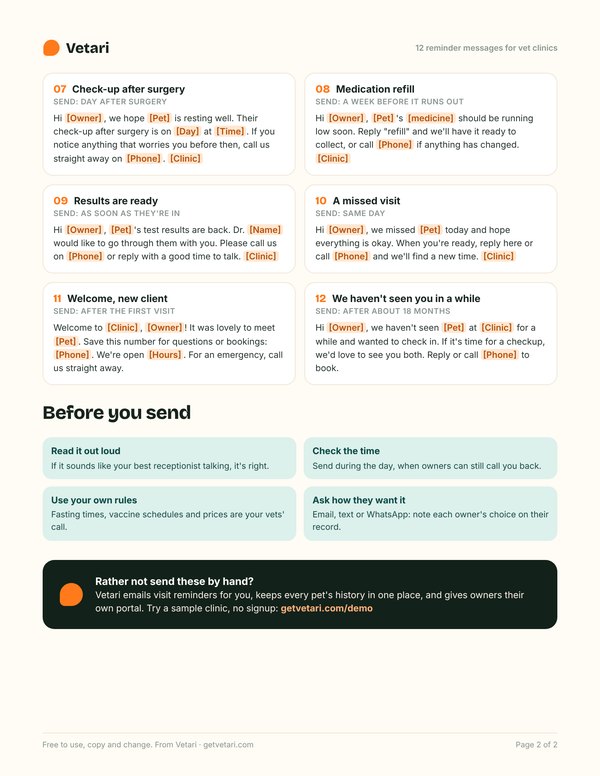
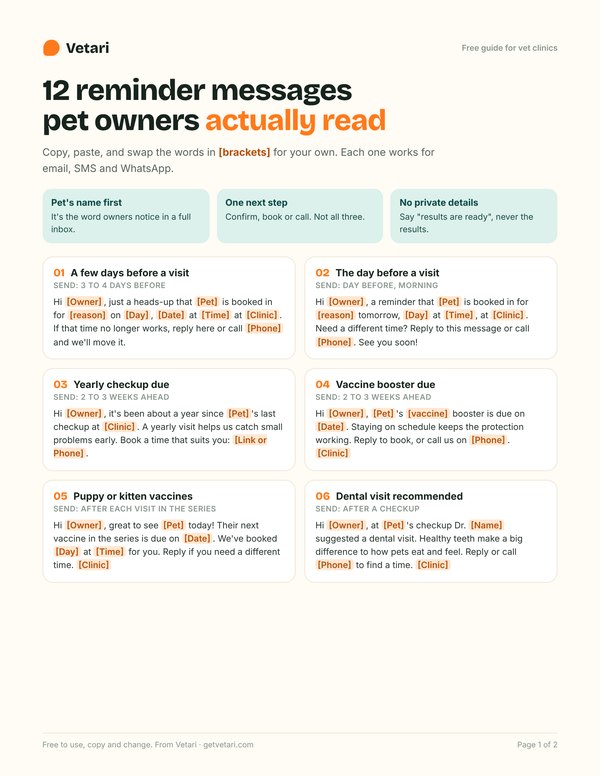
Vetari does the reminding for youReminders, pet history and owner messages in one place. Try a sample clinic, no signup.
Try the live demo